
The S$62,000 SG Child Support Package and What It Means for PR and Foreign-Parent Families
Who qualifies, what PR and foreign-parent families receive, and how the new childcare-leave reimbursement changes the employer calculation.
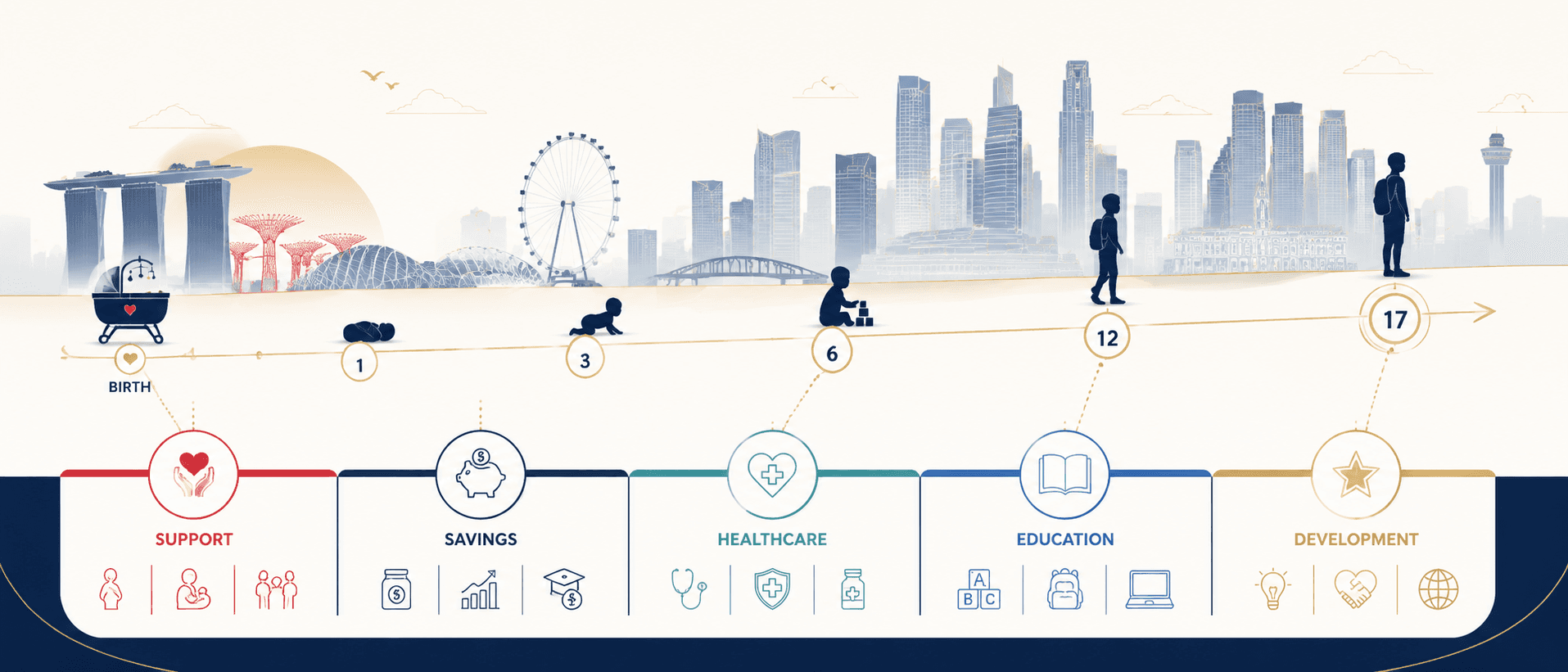
TLDR:
- The SG Child Support Package announced at the National Day Rally on 23 August 2026 pays up to S$62,000 per child, plus about S$7,500 in existing grants.
- Every component is tied to one condition: the child must be a Singapore Citizen.
- A child born in Singapore to two Permanent Resident parents is not a Singapore Citizen at birth, so that family receives none of it.
- A child born in Singapore with at least one Singapore Citizen parent is a citizen by birth and qualifies in full.
- The gap between a PR household and a citizen household just widened by roughly S$42,000 for a first child.
- Citizenship changes more than the headline figure: it can save S$75,000+ in Additional Buyer’s Stamp Duty on a S$1.5M first home, it changes Primary 1 school-registration priority, and — for many families — it changes nothing about National Service or CPF rates beyond what already applied as a Permanent Resident.
- Policy current as of August 2026. The Ministry of Social and Family Development will publish fuller details in early 2027.
The SG Child Support Package pays up to S$62,000 per Singapore Citizen child from birth to age 17, and the qualifying condition is the child’s citizenship rather than the parents’. Prime Minister Lawrence Wong announced the package at the National Day Rally on 23 August 2026. Coverage since then has focused on the amount. The eligibility gate matters more to foreign-parent households, because a Permanent Resident child and a Dependant’s Pass child receive nothing from this package. Around 610,000 Singapore Citizen children in about 380,000 households are expected to benefit, according to the Ministry of Social and Family Development. E&H Immigration Consultancy has set out below who qualifies, what the money is worth by family situation, what citizenship changes beyond the headline figure — property tax, school registration, National Service and CPF — and which parts of the rules the Government has yet to publish.
What is in the SG Child Support Package?
The SG Child Support Package replaces the Baby Bonus Scheme and the Large Families Scheme with a single flat amount of up to S$62,000 per Singapore Citizen child, paid from birth to age 17 regardless of birth order.
| Component | Amount | When it is paid |
|---|---|---|
| Baby Gift (cash) | S$10,000 | Two tranches within 12 months of birth |
| Child Credits (cash) | S$32,000 | S$2,000 a year, from the year the child turns 1 to the year the child turns 16 |
| CDA First Step Grant | S$5,000 | At birth, into the Child Development Account |
| CDA Government co-matching | Up to S$5,000 | Matched against parent savings, until the end of the year the child turns 16 |
| PSEA top-up | S$10,000 | Into the Post-Secondary Education Account, in the year the child turns 17 |
| Package total | Up to S$62,000 | Birth to age 17 |
Two older grants continue alongside the package and lift the headline figure to roughly S$69,500. A S$5,000 MediSave Grant for Newborns is credited at birth, and Edusave contributions of about S$2,500 accumulate across primary and secondary school. Source: population.gov.sg and madeforfamilies.gov.sg, National Day Rally 2026 measures, August 2026.
Who qualifies for the SG Child Support Package?
Only a Singapore Citizen child qualifies, and the parents’ own status has no bearing on it.
The Government’s wording is consistent across every component: support goes to "every Singapore Citizen child". A Permanent Resident child does not qualify. A child on a Dependant’s Pass or a Long-Term Visit Pass does not qualify. The rule cuts the other way too, and favourably: a Singapore Citizen child whose parents are both foreigners still receives the full package, because eligibility follows the child.
The design choice makes this an immigration story rather than a parenting one. The S$62,000 sits behind the citizenship line. A foreign-parent household reaches it only when the child holds Singapore Citizenship.
Does a child born in Singapore to PR parents get the S$62,000?
No. A child born in Singapore to two Permanent Resident parents is not a Singapore Citizen at birth, so the child receives nothing from the SG Child Support Package.
Article 121 of the Constitution of the Republic of Singapore sets the test. A child born in Singapore is a citizen by birth only where at least one parent is a Singapore Citizen at the time of the birth. Two Permanent Resident parents do not meet that condition. The Immigration & Checkpoints Authority (ICA) treats such a child as a non-citizen from day one. A child who is not a Singapore Citizen at birth holds a special pass valid for 42 days. The parents must secure a proper immigration pass before the special pass expires.
Permanent Residency for the child is a separate application, sponsored by the parents. A grant of Permanent Residency does not unlock the package. Only a grant of citizenship does.
What if one parent is a Singapore Citizen and the other is a foreigner?
A child born in Singapore with at least one Singapore Citizen parent is a Singapore Citizen by birth and qualifies for the full S$62,000.
Article 121 of the Constitution requires only one citizen parent. A Singaporean married to a foreign spouse therefore has a citizen child from birth. The household receives the Baby Gift, the Child Credits, both Child Development Account components and the Post-Secondary Education Account top-up on the same terms as any other citizen family.
The foreign spouse’s own status is a separate question. ICA has stated publicly that foreign parents of Singaporean children are not automatically granted Permanent Residency. Every such application is assessed holistically against the same criteria as any other. Foreign parents who fall short may apply for a Long-Term Visit Pass (LTVP), with LTVP+ available to those who meet the prevailing conditions.
What about a child born overseas to a Singaporean parent?
A child born outside Singapore to a Singapore Citizen parent is eligible for citizenship by descent, but the citizenship must be applied for rather than assumed.
Article 122 of the Constitution governs citizenship by descent. The Singapore Citizen parent registers the birth with the local authorities and obtains the overseas birth certificate. The parent then submits a citizenship application for the child through ICA. Where the Singaporean parent is themselves a citizen by descent, a further residence condition applies before citizenship can pass down another generation.
The practical risk for a Singaporean family posted abroad is drift. Each year that passes without a registration is a year in which the child sits outside the package. Families in this position should treat the registration as a dated task rather than an eventual one.
How much is at stake by family situation?
The value of a citizenship grant for a child has risen sharply, because the old Baby Bonus tiers have been replaced by a flat S$62,000 that a first child now receives in full.
| Family situation | Child’s status at birth | SG Child Support Package |
|---|---|---|
| Both parents Singapore Citizens | Singapore Citizen | Full amount, up to S$62,000 |
| One Singapore Citizen parent, one foreign or PR parent | Singapore Citizen by birth | Full amount, up to S$62,000 |
| Both parents Permanent Residents | Not a citizen | Nothing until citizenship is granted |
| Both parents on work passes | Not a citizen | Nothing until citizenship is granted |
| Singapore Citizen parent, child born overseas | Eligible for citizenship by descent | Full amount once citizenship is registered |
The full picture needs two numbers held apart: the S$62,000 SG Child Support Package itself, and the roughly S$69,500 headline that adds the S$5,000 MediSave Grant for Newborns and roughly S$2,500 in Edusave contributions — both unchanged, pre-existing grants that sat alongside the old scheme too. The table below states the true before-and-after by birth order, on that combined basis.
| Birth order | Old total (Baby Bonus/Large Families + MediSave/Edusave) | New total (SG Child Support Package + MediSave/Edusave) | Increase |
|---|---|---|---|
| 1st child | ~S$27,500 | ~S$69,500 | +S$42,000 |
| 2nd child | ~S$30,500 | ~S$69,500 | +S$39,000 |
| 3rd/4th child | ~S$39,500 | ~S$69,500 | +S$30,000 |
| 5th and later | ~S$45,500 | ~S$69,500 | +S$24,000 |
The 3rd-and-later figures above already include the old Large Families Scheme’s higher CDA First Step Grant and co-matching cap. They exclude the discontinued S$6,000 Large Family LifeSG Credits and the separate Large Family MediSave Grant, both of which topped up bigger families further under the old scheme. Families with three or more children should treat the “increase” figures above as a floor, not a precise reconciliation, until the Government confirms how those two items are replaced. Source: Ministry of Social and Family Development Baby Bonus/Large Families Scheme reference figures, compared against the National Day Rally 2026 SG Child Support Package announcement, 23 August 2026.
Worked examples: who receives the money?
Start with the child, not the parents: the current LifeSG package summary describes eligibility as being a Singapore Citizen child aged 17 or below. The five-year and two-of-five-years residence tests discussed below are different: they concern whether a certain Singapore Citizen parent can pass citizenship by descent to a child born overseas. They are not a general residence test for an already-citizen child.
These are timeline illustrations of the announced framework, not a promise that every family will receive every dollar. The Government has not yet published every rule for children who acquire citizenship after birth, or every cross-border administration detail.
- Family moves overseas while the child remains Singaporean: Rachel, 35, is a Singapore Citizen by birth; Daniel, 37, is Australian; and their son Ethan is born in Singapore on 1 May 2027. The family moves to Perth in July 2032, just after Ethan turns 5. On the published schedule, the move itself does not change Ethan’s citizenship or age. If he remains a Singapore Citizen, the family would still plan around 11 remaining Child Credits years from ages 6 through 16 (11 × S$2,000 = S$22,000) and the S$10,000 PSEA top-up in the year he turns 17. His Baby Gift and CDA First Step Grant were birth-stage items, and CDA co-matching still depends on savings and the cap. The family should not assume that an overseas school can use ring-fenced CDA or PSEA funds, or that future payments continue if Ethan later gives up Singapore citizenship; the final cross-border and loss-of-citizenship rules must be checked.
- PR parents move with two non-citizen children: Siti, 38, and Ken, 40, are both Permanent Residents. Their children Noah, 9, and Leila, 4, are not Singapore Citizens when the family relocates to Vancouver in 2027. Neither child receives the SG Child Support Package merely because the parents held PR or lived in Singapore. Moving abroad does not create an entitlement, and applying for the parents’ citizenship later does not automatically make either child a citizen. If one parent is instead on a Dependant’s Pass, that parent’s own route is separate; see our Dependant’s Pass and PR guide. If a child later becomes a Singapore Citizen, the Government has not yet published whether the child receives all earlier Child Credits or only future support, so the family should not budget on an assumed S$62,000 catch-up.
- Less than five years in total, but at least two in the preceding five: Amina, 33, is a Singapore Citizen by descent. She lived in Singapore for three years from June 2023 to June 2026, then had a daughter born in Tokyo in March 2027. Her Singapore residence is below five years in aggregate, but it is more than two years in the five-year period before the birth. She passes that alternative residence limb for citizenship by descent, subject to the other Article 122 conditions and registering the birth on time. If the daughter is recognised as a Singapore Citizen, the child—not Amina’s spouse’s nationality—becomes the starting point for the package analysis.
- At least five years in total, but less than two in the preceding five: Mei, 38, is also a Singapore Citizen by descent. She lived in Singapore for six years between 2012 and 2018, then worked overseas; her son was born abroad in March 2027. She has less than two years in the immediately preceding five-year window, but she satisfies the separate five-year aggregate limb. This is why “less than two years recently” does not automatically fail the citizenship-by-descent test.
- Fails both residence alternatives: Dina, 33, a Singapore Citizen by descent, lived in Singapore for three years from 2016 to 2019 and had a child born overseas in March 2027. She has less than five years in total and less than two years in the five years immediately before the birth. On those simplified facts, the child should not be treated as automatically Singaporean by descent. Until the citizenship position is resolved, the family should not count the SG Child Support Package. The ICA citizenship-by-descent guidance and the child’s registration documents matter here.
For a foreign spouse considering the family route, see our guide to Singapore PR for a spouse of a Singapore Citizen. That is a separate immigration assessment; a child’s potential benefits do not create an automatic PR or citizenship approval for either parent.
Why does this change the arithmetic of a citizenship application?
The money gap between Permanent Residency and Singapore Citizenship has been the quiet subtext of the upgrade decision for years. Families weighing the immigration route can start with our Singapore PR application guide, but the package is not itself a PR or citizenship pathway. The National Day Rally 2026 measures widen that gap sharply for anyone raising young children.
Three points deserve attention from parents weighing the timing of an application.
First, the Child Credits are paid each year against the child’s age, from the year the child turns 1 to the year the child turns 16. A schedule of that shape means a later citizenship grant leaves fewer years on the table. The cost of delay therefore carries a number rather than a vague sense of loss.
Second, the Baby Gift of S$10,000 is tied to the first 12 months after birth. A citizenship grant that lands after the child’s first birthday falls outside that window. The Government has not said whether a late grant attracts a back-payment.
Third, the package is only part of the picture. Full childcare and infant care subsidies, the higher childcare leave entitlement and the extra Build-To-Order ballot chance are all counted per Singapore Citizen child as well. The combined effect across preschool fees, housing ballots and parental leave runs well past the S$62,000 headline.
None of the above makes a citizenship application right for every family. Timing matters. National Service applies to a male child. Some families must give up a prior nationality, because most countries do not allow dual citizenship with Singapore. The strength of the parents’ own profiles bears on the decision too. A larger benefit on the other side of the line is a reason to plan carefully, and not on its own a reason to apply.
How much does citizenship save on property tax alone?
The Additional Buyer’s Stamp Duty (ABSD) gap between a Permanent Resident and a Singapore Citizen is often a bigger single number than the entire SG Child Support Package — and it lands as a lump sum on one property purchase, not spread over 17 years.
| Buyer status | 1st residential property | 2nd residential property | 3rd and subsequent |
|---|---|---|---|
| Singapore Citizen | 0% | 20% | 30% |
| Permanent Resident | 5% | 30% | 30% |
On a S$1.5 million first home, that 5-percentage-point gap is S$75,000 payable at the point of purchase — more than the entire S$62,000 child package, due immediately rather than across 17 years. On a S$1.2 million second property, the 30% vs 20% gap is S$120,000. These rates have held since April 2023 and remain current as of this update. Source: Inland Revenue Authority of Singapore (IRAS), Additional Buyer’s Stamp Duty schedule.
This is the one financial comparison newswire coverage of NDR 2026 never made, because the announcement was about children, not property. For a PR family already planning a home purchase, the ABSD saved by holding citizenship at the point of purchase can dwarf the child package — worth modelling before deciding when in a citizenship timeline to buy.
Does Singapore Citizenship affect Primary 1 school registration priority?
Yes. Singapore Citizen children get priority over Permanent Resident children at every Primary 1 registration phase, and popular schools can fill up before the PR priority group is reached.
In Phase 2C — the phase most families register in — priority within an oversubscribed school runs by distance first among Singapore Citizens (Priority 1: within 1km, Priority 2: 1–2km, Priority 3: beyond 2km), and only after all three Citizen distance tiers are filled does the school consider Permanent Resident children (Priority 4, by the same distance tiers). A Citizen child living more than 2km from a sought-after school can be admitted ahead of a PR child living next door.
This matters for the same families the child package targets, because it runs on a different clock. The child package pays out from birth to age 17; a Primary 1 registration decision has to be made by around the child’s sixth year, often years before the bulk of the Child Credits would have accrued anyway. A family timing a citizenship application purely around the child package’s cash schedule could miss the more time-sensitive school-registration window. Source: Ministry of Education (MOE), Primary 1 Registration phases and priority groups.
Does applying for citizenship create a National Service obligation that PR status doesn’t already carry?
Usually not — for most Permanent Resident sons, National Service liability already exists as a PR, tied to the age they were granted PR status, not to whether they later become a citizen.
The operative threshold is age 16½, not citizenship. A male granted Permanent Residency before turning 16½ — whether born in Singapore to PR parents, or added to a parent’s PR application as a dependant — becomes NS-liable as a PR at that point. Converting him to citizenship afterward does not create a new obligation; it was already there. A male granted PR only after 16½ is generally not NS-liable at all, as either a PR or, later, a citizen.
The practical implication for our audience: if a son has already held PR since before 16½, the National Service question is not a new cost of pursuing citizenship — it was decided the day the family’s PR was granted. The child package money, in that specific case, comes without the additional NS liability sometimes assumed to be the trade-off. This is a narrow but genuinely useful distinction, and one worth confirming against your own family’s PR-grant date and MINDEF’s current rules rather than assuming either way — the age-16½ threshold and the first-/second-generation PR distinction both affect the answer. Sources: Immigration & Checkpoints Authority (ICA) and Ministry of Defence (MINDEF) national service liability guidance.
Does becoming a citizen change CPF contribution rates?
No, not for a Permanent Resident who has already held PR status for three years or more — a common assumption worth correcting before it shapes a citizenship decision.
CPF contribution rates for a new PR are graduated: roughly 5% employee / 4% employer in the first year of PR status, rising to about 15% employee / 9% employer in the second year, then reaching the full rate — the same rate a citizen pays — from the third year onward. A PR who has already been through that two-year ramp-up is already contributing at the citizen rate. Citizenship itself does not raise it further.
Worth stating plainly because it is easy to conflate with the child package: the NDR 2026 announcement changed nothing about CPF contribution mechanics. Anyone weighing citizenship for a CPF-rate benefit that they may already have as a longer-tenured PR should look at the SG Child Support Package, ABSD and school-priority angles above instead — those are where the real citizenship-linked differences sit. Source: CPF Board, CPF contribution rate tables for Singapore Permanent Residents.
What if my home country will not let me renounce my citizenship?
Singapore generally requires proof that a new citizen is renouncing any prior citizenship, but how fast — and how expensive — that renunciation is depends entirely on the other country, not on Singapore.
Most countries do not permit dual citizenship with Singapore, so a successful applicant is expected to give up their existing nationality. The article above already notes this obligation; what is less often said is that the timeline sits outside Singapore’s control. Some countries process renunciation quickly and cheaply. Others charge a substantial exit fee, impose an income or asset-based exit tax, or take a year or more to process the paperwork — during which an applicant can be caught between two systems, holding a Singapore citizenship grant they cannot yet fully settle into because their prior nationality has not formally been given up.
This is a country-specific check, not a Singapore-side risk, and it belongs early in the planning process rather than late. A family should confirm their home country’s renunciation process, cost and expected timeline before committing to the citizenship route, not after receiving approval.
Which other National Day Rally 2026 measures are gated on citizenship?
Four further measures announced on 23 August 2026 use the same Singapore Citizen child test. Each one widens the gap for foreign-parent households.
Childcare leave rises to 8, 10 or 12 days a year per working parent. The number depends on whether the parent has one, two, or three or more Singapore Citizen children aged 12 and below. The Government will fund those days in full, up to the reimbursement limit, so the extra leave does not land on the employer. Full childcare and infant care subsidies will reach families with Singapore Citizen children whatever the applicant’s working status. Fees fall towards S$150 a month for childcare and S$300 a month for infant care, phased in from 2028 and targeted for completion by 2030. First-timer families receive one extra ballot chance for each Singapore Citizen child aged 18 and below. The extra chance applies to Build-To-Order and Sale of Balance Flats exercises from the February 2027 sales exercise. Households with three or more children receive further healthcare, transport and housing support, with details still to be confirmed.
A separate but related change affects housing affordability rather than eligibility: from 24 August 2026, the monthly household income ceiling to apply for a Build-To-Order flat rises from S$14,000 to S$16,000, and the Executive Condominium ceiling rises from S$16,000 to S$18,000 — the first increase since 2019. This does not change who can apply. A Permanent Resident alone still cannot buy a new BTO flat; eligibility requires a Citizen-Citizen or Citizen-PR family nucleus, or approval under the Non-Citizen Spouse Scheme. What it does is let higher-earning eligible households, previously locked out above the old ceilings, apply at all. It stacks on top of the extra per-Singapore-Citizen-child ballot chance described above, so a first-timer citizen-headed family with a higher income and Singapore Citizen children now clears two hurdles that used to block them separately.
The childcare-leave citizenship gate also has a timing edge that matters for planning. Government-Paid Childcare Leave can only be used once, and from the date, the child is a Singapore Citizen — it is not backdated to birth. A child born in Singapore to a Singapore Citizen parent is a citizen immediately, so the parents can draw the leave from day one. A child born overseas to a Singapore Citizen parent is not automatically a citizen; the parent must register the birth and apply for citizenship by descent within one year under Article 122, and the leave only becomes usable once that registration clears — a family that lets the year lapse delays its own entitlement, not just the child’s citizenship. A child who is not a Singapore Citizen at all, including a Permanent Resident child of Permanent Resident parents, draws zero days under this scheme regardless of how long the family has lived in Singapore.
The pattern is clear. Singapore has moved a large and growing block of family benefits behind the citizenship line. The practical value of citizenship to a young family has risen with it.
Do employers pay for the extra childcare leave?
No. The Government will cover the cost of every statutory child-related leave scheme for all child orders, up to the reimbursement limit, so the additional childcare leave days are funded by the state rather than the employer.
Today the cost is shared. The Government does not reimburse employers for the first 8 weeks of the 16-week Government-Paid Maternity Leave (GPML), for first and second child orders. The same gap applies to the first 4 weeks of the 12-week Government-Paid Adoption Leave (GPAL). Employers also carry the first 3 days of the 6-day Childcare Leave (CCL). Government-Paid Paternity Leave, Shared Parental Leave and Extended Childcare Leave are already reimbursed in full.
The National Day Rally 2026 measures close those gaps. The Government will cover GPML, GPAL, Government-Paid Paternity Leave, Shared Parental Leave and CCL for all child orders, up to the reimbursement limit. The employer pays the employee’s gross salary and then claims the amount back, capped at S$10,000 for every 4 weeks. Eligible Self-Employed Persons may instead claim compensation for income lost. The new CCL scheme merges the current Childcare Leave and Extended Childcare Leave into a single entitlement for parents with Singapore Citizen children aged 12 and below.
The citizenship gate reaches the employer as well. Leave entitlement counts Singapore Citizen children only. A company whose foreign staff have non-citizen children therefore sees no change to its leave bill from this announcement. Source: population.gov.sg, National Day Rally 2026 marriage and parenthood measures, August 2026.
Worked examples: what the employer pays and claims back
These examples illustrate the announced reimbursement principle using the stated S$10,000 cap per four weeks. They are not payroll advice; the final scheme rules and claim process will determine the payable amount.
- Salary below the cap: An employee takes four weeks of qualifying leave and earns S$6,000 in gross salary for that four-week block. The employer still pays the employee S$6,000, then claims S$6,000 from the Government. That is below the S$10,000 cap, so the reimbursable salary amount is S$6,000, subject to eligibility and an approved claim.
- Salary above the cap: An employee earns S$14,000 in gross salary for the same four-week block. The employer must still pay S$14,000, but the announced cap would leave S$10,000 reimbursable and S$4,000 with the employer. The cap limits reimbursement; it does not limit the employee’s contractual salary.
- Extra childcare leave: If a qualifying employee takes eight announced childcare-leave days at an illustrative gross daily rate of S$350, the employer pays S$2,800 and would claim that amount back because it is below the stated four-week cap. If the employee’s child is not a Singapore Citizen, the announced citizenship gate may mean the new entitlement does not arise in the first place.
For the current childcare-leave claim mechanics, see the Ministry of Social and Family Development’s Pro-Family Leave guidance. The NDR 2026 expansion remains subject to the Government’s final implementation rules.
What has the Government not yet published?
Several questions that matter most to foreign-parent families are still unanswered as of August 2026. Honest planning requires naming them.
The biggest gap concerns a mid-childhood citizenship grant. Neither the Ministry of Social and Family Development nor ICA has published how the Child Credit schedule treats a child who becomes a Singapore Citizen at, say, age 6. The child might start drawing S$2,000 a year from the grant onwards. The child might instead receive a catch-up for the earlier years. Neither outcome has been stated. The published transitional rules address existing Singapore Citizen children rather than new ones, so the point stays open.
The Baby Gift back-payment question is also unresolved. Existing Singapore Citizen children born before 1 April 2027 receive a top-up by 30 April 2027 to reach the S$10,000 equivalent. No comparable statement covers a child who becomes a citizen after that date.
The Ministry of Social and Family Development has said fuller recommendations will follow in early 2027. E&H Immigration Consultancy will update this article once the details are published.
What should a PR or work-pass family do now?
Five practical steps follow from the announcement, and none of them require a decision before the details land in early 2027.
- Confirm the child’s actual status on paper. A birth certificate issued in Singapore does not confer citizenship, and parents should check the child’s immigration pass and citizenship status rather than assume.
- For a child born overseas to a Singapore Citizen parent, start the citizenship by descent registration now. The application runs through ICA on Singpass and depends on the overseas birth certificate being in hand.
- Cost the delay honestly. Multiply the remaining years to the child’s sixteenth birthday by S$2,000 to see what an additional year of waiting is worth in Child Credits alone, then set that against the case-strength reasons for waiting.
- Assess whether the parents’ profiles support a citizenship application at all. Singapore Citizenship is normally open to Permanent Residents after a qualifying period, and the strength of the case rests on employment, income, residence history, family ties and integration.
- Weigh the obligations alongside the benefits. National Service applies to male citizens and to second-generation male Permanent Residents, and most countries require a Singaporean citizen to renounce a prior nationality.
Approval is determined solely by ICA, and no consultancy can promise an outcome. Preparation determines how well a case is presented, and nothing more than that.
Speak to E&H Immigration Consultancy about the timing of your family’s application
E&H Immigration Consultancy advises professionals, families and business owners on Permanent Residency, Singapore Citizenship, work passes, Long-Term Visit Passes and appeals. The firm brings 25+ years of immigration experience across 1,000+ applications, with clients from 40+ countries. E&H Immigration Consultancy tracks ICA policy announcements and approval trends to inform every application strategy, and will tell a family plainly when the timing is wrong.
Book a consultation to review your household’s position against the National Day Rally 2026 measures. A consultant will map the order in which the parents and the child should apply. Contact E&H Immigration Consultancy at info@eh-immigration.com or +65 8785 5563.
Do PR children get any part of the SG Child Support Package?
No. A Permanent Resident child receives no part of the SG Child Support Package, because every component is reserved for a Singapore Citizen child.
Permanent Residency carries other benefits for a child, including subsidised school fees and access to public healthcare subsidies. The SG Child Support Package sits outside that set entirely.
My child is a Singapore Citizen but my spouse and I are foreigners. Do we qualify?
Yes. Eligibility follows the child’s citizenship, so a Singapore Citizen child qualifies in full even where both parents are foreigners.
The parents’ own immigration status is assessed separately by ICA and has no bearing on the child’s entitlement under the package.
When does the SG Child Support Package start?
The package takes effect from 1 April 2027, with parts of it back-extended to existing Singapore Citizen children during 2026 and 2027.
The Baby Gift applies to children born from 1 April 2027 onwards. Existing Singapore Citizen children turning 1 to 16 in 2026 receive their Child Credits by 30 April 2027. Children born before 1 April 2027 receive a top-up by the same date to reach the S$10,000 Baby Gift equivalent. Existing Child Development Account co-matching caps hold until 30 September 2027. The flat S$5,000 cap then applies from 1 October 2027.
In dollar and percentage terms, the S$62,000 package itself is not phased in — it pays out in full, on the schedule above, to any qualifying Singapore Citizen child. The Baby Gift (S$10,000, about 16% of the package) is front-loaded within the first 12 months. The Child Credits (S$32,000, about 52%) pay out over 16 years from age 1 to 16, and already reach existing Singapore Citizen children under 16 by 30 April 2027 rather than only children born after 1 April 2027. The CDA First Step Grant and co-matching (up to S$10,000, about 16%) land in the early years. The PSEA top-up (S$10,000, about 16%) arrives at 17. The one genuinely delayed benefit sits outside the S$62,000 package: the childcare and infant care fee cuts to S$150 and S$300 a month phase in progressively from 2028 and are only targeted for full effect by 2030, so a child born in 2027 will not see the lower fee on day one.
If my child becomes a Singapore Citizen at age 6, do we get the earlier years?
The Government has not published an answer to this question as of August 2026.
The transitional rules released so far cover existing Singapore Citizen children rather than children who become citizens later. The Ministry of Social and Family Development has said fuller details will follow in early 2027. Families in this position should plan on the published rules rather than on an assumed catch-up.
Does having a Singapore Citizen child improve my own PR or citizenship application?
Family ties in Singapore are one factor among several that ICA weighs, and a Singapore Citizen child does not create an entitlement to Permanent Residency or citizenship.
ICA has stated that foreign parents of Singaporean children are assessed alongside every other applicant. Employment, income, length of residence, qualifications and integration all bear on the outcome. Approval is not guaranteed. Eligibility is determined solely by ICA.
Does Singapore Citizenship reduce Additional Buyer’s Stamp Duty (ABSD) on property?
Yes. A Singapore Citizen pays 0% ABSD on a first residential property and 20% on a second, against 5% and 30% for a Permanent Resident — a gap that can exceed the entire child package on a single purchase.
On a S$1.5 million first home the 5-point gap is S$75,000, payable up front rather than across 17 years. See the ABSD comparison above for the full schedule and a second-property worked example.
Does becoming a Singapore Citizen change my child’s Primary 1 school registration priority?
Yes. Singapore Citizen children are prioritised over Permanent Resident children at every Primary 1 registration phase, including within the same distance band.
In the most-used phase (2C), all Citizen distance tiers are filled before any Permanent Resident child is considered, regardless of how close that PR child lives to the school. See the Primary 1 section above for the full priority order.
Do I have to serve National Service if I give up PR and become a Singapore Citizen?
For most Permanent Resident sons, National Service liability was already set when PR was granted — not by the later decision to become a citizen.
A male granted PR before age 16½ is NS-liable as a PR already; converting to citizenship afterward does not create a new obligation. See the National Service section above for the exact threshold and the cases where this differs — confirm your family’s specific position with ICA or MINDEF rather than assuming.
Not sure where you stand?
Get a personalised assessment of your Singapore PR, citizenship, or work pass options from E&H Immigration’s specialists.